
Isaiah 41:1-29
“You whom I took from the ends of the earth, and called from its farthest corners,
saying to you, ‘You are my servant, I have chosen you and not cast you off";
fear not, for I am with you; be not dismayed, for I am your God; I will strengthen you,
I will help you, I will uphold you with my righteous right hand. (Isaiah 41:9-10)
The beginning of what is commonly called “Second Isaiah” in chapter 40— think of it like a sequel to a blockbuster movie— provides the answer to what came next after the epic failure of good King Hezekiah.
Hezekiah accomplished so much during his reign, that one might have thought he had turned the tide towards a golden age for Judah. But not so fast! In the end, feet of clay overwhelmed his usual faithfulness: much success, followed by much pride, followed by the covetousness for alliances short of God— enter then, Babylonian envoys, and the final verdict of Exile rains on the parade (39:6): Isaiah thunders, “Behold, the days are coming, when all that is in your house, and that which your fathers have stored up till this day, shall be carried to Babylon.”
In the face of this dark judgment— fulfilled one hundred years later in 586 BC when those Babylonian allies became conquerors— God speaks life! (40:1-3) “Comfort, comfort my people, says your God. Speak tenderly to Jerusalem, and cry to her that her warfare is ended, that her iniquity is pardoned, that she has received from the LORD's hand double for all her sins. A voice cries: ‘In the wilderness prepare the way of the LORD; make straight in the desert a highway for our God.’” Those beautiful words mean the curse of exile is ending; sins are pardoned; and God is coming back to tabernacle in their midst, just as he did in the wilderness shekinahs of cloud and fire, and the Jerusalem Temple. They are His People; and He is their God. His strong arm will complement His tender shepherd’s embrace.
This is usually as far as we get into this Isaiah passage, resting content that it has brought us the meaning of Jesus in the Gospels and the New Testament. Nothing more to see here, move on! And yet there is so much more to see. Isaiah 40 is mere prologue to God’s global rescue mission. “Second Isaiah” introduces a mysterious “Servant” who will accomplish this exhaustive redemption and reconciliation. The message and meaning thusly, succinctly: The original mission bequeathed to Adam and Eve, Noah, Abraham, Moses and collectively to God’s “Son” Israel was to be resumed. The call was to be a Kingdom of Priests, showing the way back to Eden and relationship with the Creator God.
Our lesson this week (40:12-31, 41:1-29) is the set-up for this return to mission. God reminds the returning expatriates that it was He who moved the mighty Cyrus the Great, the Persian king who conquered Babylon, into setting the exiles free to return to rebuild the Jerusalem Temple (41:2-4), “Who stirred up from the east whom victory meets at every step.” “Who has performed and done this, calling the generations from the beginning? I, the LORD, the first, and with the last; I am he[!]” The decree of Cyrus setting the captives free is epoch, but this worldly king will have no further role in effecting the redemption of the world.
Isaiah re-christens this original role (41:8-10): “But you, Israel, my servant, Jacob, whom I have chosen, the offspring of Abraham, my friend; you whom I took from the ends of the earth, and called from its farthest corners, saying to you, ‘You are my servant, I have chosen you and not cast you off.’ …Fear not, you worm Jacob, you men of Israel! I am the one who helps you, declares the LORD; your Redeemer is the Holy One of Israel.” (Isa. 41:8-9, 14)
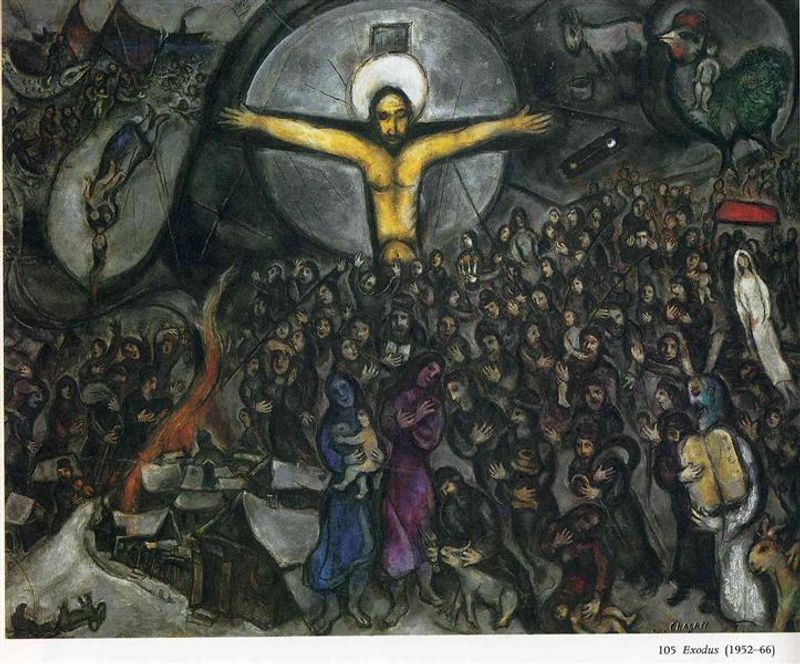
God’s people are the Servants. Big Call, and they know it upfront, and therefore do not believe they are up to it. They think they are mere “worms.” How can they who were captives, still landless, temple-less, hopeless, and weak make this happen? The answer forthcoming is the promise of a Second Exodus— one even greater than the miraculous Red Sea exit from Egypt. Listen to the Exodus language used to paint this salvific work God will work (41:18-20):
“I will open rivers on the bare heights, and fountains in the midst of the valleys.
I will make the wilderness a pool of water, and the dry land springs of water.
I will put in the wilderness the cedar, the acacia, the myrtle, and the olive.
I will set in the desert the cypress, the plane and the pine together,
that they may see and know, may consider and understand together,
that the hand of the LORD has done this, the Holy One of Israel has created it[!]”
God is restarting the original calling of world reconciliation. This was the mission of the Mosaic generations, but as the books of Joshua, Judges, Samuel, Kings tell the Story, it is painfully obvious that it was always and ever a failure to launch. Nevertheless, Isaiah speaks of this Second Exodus as a do-over. Let’s get it right this time! God’s “Servant” will lead the way. You (i.e. Y’all) will lead the way!
Now here is where God’s Word proves to be a multi-layered treasure that requires study and meditation to unpack and appreciate. There will be four “Servant Songs” to fill out this second book of Isaiah (see 42:1-1-9; 49:1-13, 50:4-11; 52:13-15 – 53:1-12). With each succeeding “Song” the “Servant” will narrow down from Israel as a nation— morphing into a single, solitary figure we know otherwise as the long-expected Messiah— revealed in the New Testament Gospels as Jesus of Nazareth.
The inconvenient truth is that Israel was never up to, or ever will be able to accomplish the role of the “Servant.” At least, not in their own strength. Even as they are identified as the “Servant” here, the end of the chapter gives us another cliffhanging To Be Continued… (41:27-29) “Behold, here they are!” [Israel, My Servant!] and [through them] I give to Jerusalem a herald of good news [The Gospel!].” All good so far. But then the drop: “But when I look, there is no one; among these there is no counselor who, when I ask, gives an answer. Behold, they are all a delusion…” Again, failure to launch!
This uneasy segue leads awkwardly into next week’s lesson in Isaiah 42. There the First Servant Song of Isaiah will begin to unpack the transition of this mysterious Messianic figure from plural to singular. As has already been suggested, this Messianic Servant is ultimately fulfilled in the Lord Jesus Christ. But what we need to take to heart with this origin Story of sorts with this Servant Redeemer, is that although the Servant is given final meaning in the person of Christ, we will come to see that the People of God will be incorporated, as the Church, the Israel of God, empowered by the Spirit, In Christ, to successfully accomplish the original calling! We are called now to be the mouth, the feet, the hands and the soul of this Servant mission.
Remember what Jesus said at the end of his earthly ministry: “All authority in heaven and on earth has been given to me. Go, therefore, and make disciples of all nations…” Because of what we are reading here in Isaiah, we know we can.
The Story continues…
Art: Marc Chagall, "Exodus" (1952–1966)
