
Isaiah 39:1-8; 40:1-5
“Comfort, comfort my people, says your God.”
Chapters 39 and 40 of Isaiah can be thought of as a sort of transition between two epochs of time. Think of the way the birth of the Lord Jesus Christ connects to time BC to AD. Isaiah 36-39 recounts the end of the prophet’s earthly career during the reign of King Hezekiah when the Assyrian King, Sennacherib is bearing down on Judah. The second largest city of Lachish was conquered before the heat was turned up on Jerusalem.
Isaiah 36:1-22 recalls the siege of the Holy City. The mighty Assyrian army was haughty and ready to carry king and city away in exile. “Thus says the great king, the king of Assyria: On what do you rest this trust of yours? …Hear the words of the great king, the king of Assyria! Thus says the king: 'Do not let Hezekiah deceive you, for he will not be able to deliver you. Do not let Hezekiah make you trust in the LORD by saying, the LORD will surely deliver us. This city will not be given into the hand of the king of Assyria” (36:4, 13-15). But Hezekiah stands fast in faith and commands his officers to say nothing. His faith is strong.
Isaiah 37:1-38 then fills out the heroic rest of the story. Hezekiah falls to his face and cries to God in Prayer— “O LORD of hosts, God of Israel, enthroned above the cherubim, you are the God, you alone, of all the kingdoms of the earth; you have made heaven and earth. Incline your ear, O LORD, and hear; open your eyes, O LORD, and see; and hear all the words of Sennacherib, which he has sent to mock the living God” (37:16-17). And without a single shot being fired, God delivers Hezekiah and Jerusalem. His faith is even stronger.
Moving to Isaiah 38:1-22, the reign of Hezekiah appears to be winding down. The king takes to his death bed and Isaiah tells him to set his affairs in order. But this king of faith once again exercises this connection: “‘Please, O LORD, remember how I have walked before you in faithfulness and with a whole heart, and have done what is good in your sight.’ And Hezekiah wept bitterly” (38:3). The plans change, and God relents to give Hezekiah an extra fifteen years of life.
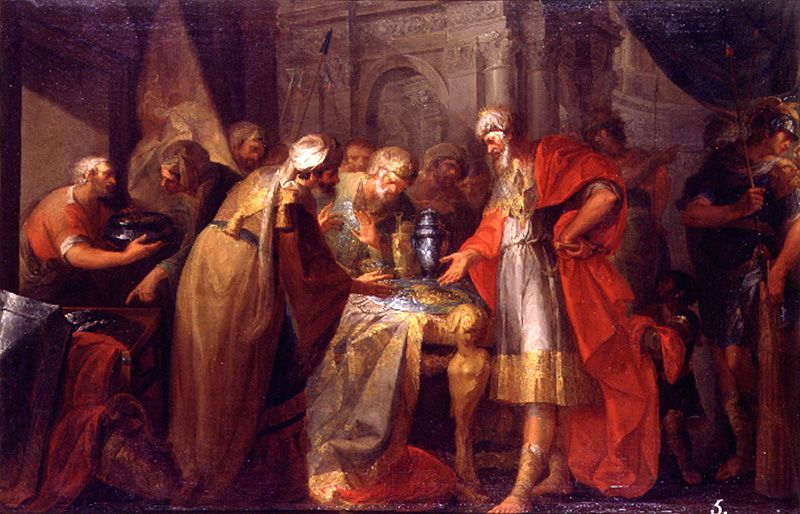
These fifteen years prove to be less faithful for the king and the kingdom. Isaiah 39:1-8 sees envoys from the ascendant kingdom of Babylon at the doorstep. Envoys from Babylon come to Jerusalem, and Hezekiah shows off all the treasures of the Temple, in an attempt to curry favor with this rising presence in the region. The upshot of the matter is that Hezekiah has drifted from his faith roots and is now leaning into political practicalities: Seeking out powerful allies for future safety. Even as God has been all sufficient for Hezekiah and Jerusalem, now that faith seems to be fading.
When Isaiah finds out the kings impromptu Temple tour of the Babylonian delegation, he comes forth with some stern words for the king. “Hear the word of the LORD of hosts: Behold, the days are coming, when all that is in your house, and that which your fathers have stored up till this day, shall be carried to Babylon. Nothing shall be left, says the LORD. And some of your own sons, who will come from you, whom you will father, shall be taken away, and they shall be eunuchs in the palace of the king of Babylon” (39:5-7). And Hezekiah’s response has puzzled readers for years. “That’s good. At least I can live out my days in peace!”
A charitable interpretation of the king’s seemingly devil may care response is that he believes his sons will be godly enough to change their ways to repentance when the hour approaches, and God would relent and sustain them. But most interpreters do not see this ray of sunshine. This is the dark chapter bringing down the curtain to the first book of Isaiah. The word, as it was for Israel to the north, will be exile for the southern kingdom of Judah.
Turn the page to a new beginning. The time has advanced one hundred years. Judah is indeed cooling their heels in Babylonian exile. But we encounter another heaven throne room scene, similar to the “Holy, Holy, Holy” encounter back in Isaiah 6 that the prophet is once again the proverbial fly on the wall. It will be an unexpected turn. God’s people are getting their just deserts for their faithlessness. Even so, God will not— will never abandon his people. Ever.
“Comfort, comfort my people, says your God. Speak tenderly to Jerusalem, and cry to her that her warfare is ended, that her iniquity is pardoned, that she has received from the LORD's hand double for all her sins.” (40:1-2). The word is forgiveness and restoration. Better yet, the word that goes out from the throne room is that God will be coming back to be with his people. Just like he was in the wilderness journeys. Just like he the days when his footstool was between the two cherubim in the Holy of Holies of the Jerusalem Temple. “A voice cries: ‘In the wilderness prepare the way of the LORD; make straight in the desert a highway for our God. Every valley shall be lifted up, and every mountain and hill be made low; the uneven ground shall become level, and the rough places a plain. And the glory of the LORD shall be revealed, and all flesh shall see it together, for the mouth of the LORD has spoken’” (40:3-5).
As we open the Gospel of John, John is declaring that this Isaianic prophecy is fulfilled in Jesus Christ. “The Word became flesh and dwelt among us, and we have seen his glory, glory as of the only Son from the Father, full of grace and truth. …No one has ever seen God; the only God, who is at the Father's side, he has made him known” (Jn. 1:14, 18).
It is the prophet Isaiah who gives us a taste of God’s love that we experience in Jesus. As we being N.T. Wright’s book “Into the Heart of Isaiah,” we will see how this story of love plays out through the so-called four “Servant Songs,” culminating in a salvation that encompasses the entire world. And that, I must say, is really an unexpected turn!
Art: Hezekiah and the Babylonian Envoys by Vicente López Portaña (1772–1850)
