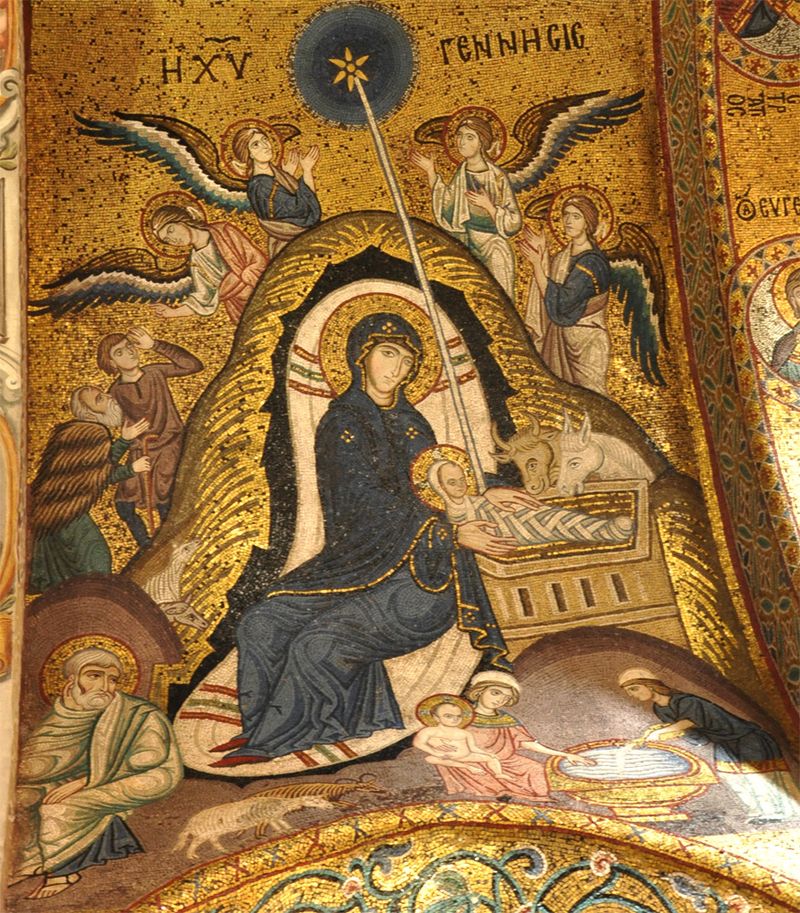
Luke 2:1-20
In those days a decree went out from Caesar Augustus that all the world should be registered. This was the registration before Quirinius was governor of Syria. And all went to be registered, each to his own town. And Joseph also went up from Galilee, from the town of Nazareth, to Judea, to the city of David, which is called Bethlehem, because he was of the house and lineage of David, to be registered with Mary, his betrothed, who was with child. And while they were there, the time came for her to give birth. And she gave birth to her firstborn son and wrapped him in swaddling cloths and laid him in a manger, because there was no place for them in the inn. And in the same region there were shepherds out in the field, keeping watch over their flock by night. And an angel of the Lord appeared to them, and the glory of the Lord shone around them, and they were filled with great fear. And the angel said to them, “Fear not, for behold, I bring you good news of great joy that will be for all the people. For unto you is born this day in the city of David a Savior, who is Christ the Lord. And this will be a sign for you: you will find a baby wrapped in swaddling cloths and lying in a manger.” And suddenly there was with the angel a multitude of the heavenly host praising God and saying, “Glory to God in the highest, and on earth peace among those with whom he is pleased!” When the angels went away from them into heaven, the shepherds said to one another, “Let us go over to Bethlehem and see this thing that has happened, which the Lord has made known to us.” And they went with haste and found Mary and Joseph, and the baby lying in a manger. And when they saw it, they made known the saying that had been told them concerning this child. And all who heard it wondered at what the shepherds told them. But Mary treasured up all these things, pondering them in her heart. And the shepherds returned, glorifying and praising God for all they had heard and seen, as it had been told them.
During the Christmas Season of 1981, I was a senior in high school. Our youth group led worship for Youth Sunday. I remember it well. We decided that along with the liturgy and the special music we’d offer, we’d do something different for the “sermon.” We would offer a counterpoint dual presentation. Those were the days following the aftermath of the so-called Strategic Arms Limitation Talks treaties with the then Soviet Union— SALT I in 1972 and SALT II in 1979— days of the Cold War. The thought that the world could be annihilated by a nuclear bomb at any moment was the stuff of political and existential intrigue. Two of us would present the opposing sides of the debate: One for the pro-nuke view of Mutual Assured Destruction (MAD), and the other, the unconditional disarmament view.
Yours truly presented the MAD position. To be honest, I can’t remember what I said. But I do remember what my “opponent” Tom said. I’ll never forget it— “Sometimes I wonder why I’m even bothering to apply for college when the world could be blown up at any moment.”
Those words provoked me. Not for the profundity of the thought, but that this was what we chose to frame the Christmas Season at our church. Afterall, Christmas proclaims the Incarnation of the Son of God — The First Advent of the Messiah — The fruit of God’s love for the world — The world that God created and called good — The world that God promises to remake into New Creation, now with the Kingdom of God dawning in the birth of Jesus Christ. Christmas is not about a bleak future of annihilation!
Incidentally, this Youth Sunday would be a catalytic moment for me. I was a church-kid from the cradle— but a clueless kid, uninterested in God through the first seventeen years of my life. But now, this inconsequential consequential presentation provoked wonder in me. God had come in Christ. Our Immanuel. This meant the world, in the ultimate sense, had better days ahead.
For too many kids weaned and raised in the Church, they leave it after high school graduation. For me, graduation swept me through the front door of the Church. At seventeen, God became real to me — and it took a provocative, inappropriate sermon topic at Christmastime to open me up to the beauty of God in Christ at Advent and Easter and everything in between. (By the way, the idea to do the nuclear war sermon counterpoint was my idea. God does work humor into the fabric of irony quite often.)
As we come to the Christmas Story in Luke 2 tonight, I must share that I’m reconsidering the way I wrote off that Christmas Youth Sunday presentation many years ago. I am beginning to think that what we did with nuclear war and the 80’s angst of “a land of confusion” was quite appropriate and meaningful. [!]
We all know the Christmas Story by heart, I’m quite sure. Tonight, I want to briefly share some thoughts on the first two verses of the Story. Two verses that seem at first blush to be inconsequential words, a proforma entry to the Story.
In those days a decree went out from Caesar Augustus
that all the world should be registered.
This was the registration before Quirinius was governor of Syria.
Two verses essential to the Storyline: Luke wants us to understand that the Incarnation of the Son of God wasn’t some imagined fairytale or myth. He locates the Nativity amid the intrigue and uncertainty and anxiety of first century Palestine— kind of like our fears over the nuclear arms race back in 1981. This setting immediately places that first Christmas in Bethlehem in a soup of intrigue. Ironically, we always sing the beautiful words of “Silent Night, Holy Night” to close out Christmas Eve services—
Silent night, holy night
All is calm, all is bright
'Round yon Virgin Mother and Child
Holy Infant so tender and mild
Sleep in heavenly peace
Sleep in heavenly peace
Munther Isaac, the former pastor of Christmas Lutheran Church, a couple of blocks down the street from the Church of the Nativity, shared a Christmas message which calls attention to the bitter irony of this beloved Christmas carol:
“The familiar lines of the Christmas song Silent Night obscure the true nature of the story: Jesus was not born into serenity but into upheaval. [The Lord Jesus] was born under military occupation, [think Caesar Augustus and the governor of the region, Publius Sulpicius Quirinius] to a family displaced by an imperial decree [all the world to be registered for tax purposes], in a region living under the shadow of violence [the political turmoil and heavy shadow of the Roman Empire]. The holy family was forced to flee as refugees because the infants of Bethlehem, according to the Gospel narrative, were massacred by a fearful tyrant [Herod the Great, and subsequently his incompetent son, Archelaus, both] determined to preserve [their] reigns. Sound familiar?”
Munther continues, “Indeed, Christmas is a story of empire, injustice and the vulnerability of ordinary people caught in its path. For many in the West, Bethlehem – the birthplace of Jesus – is a place of imagination — a postcard from antiquity, frozen in time. The ‘little town’ is remembered as a quaint village from scripture rather than a living, breathing city with actual people.”
And then this sober conclusion: He says, “For Palestinians today, [the Christmas Story] is not merely theology — it is lived experience. When we read [it], we recognize our own world: the census that forced Mary and Joseph to travel resembles the permits, checkpoints and bureaucratic controls that shape our daily lives today. The holy family’s flight resonates with the millions of refugees who have fled wars across our region. Herod’s violence echoes in the violence we see around us.”
Here in the United States, we know that we are all too often consumed by the worries of life in the modern world. Our newsfeeds are chock full of doom and gloom. We may not have the nuclear worries of my teen years, but there are so many more dark clouds that have arisen to take pride of place. Nevertheless, into this anxiety-ridden world of human intrigue, Luke speaks a different word, a word of hope!
In the same region there were shepherds out in the field, keeping watch over their flock by night. And an angel of the Lord appeared to them, and the glory of the Lord shone around them, and they were filled with great fear. And the angel said to them, “Fear not, for behold, I bring you good news of great joy that will be for all the people. For unto you is born this day in the city of David a Savior, who is Christ the Lord.”
The Christmas Story concludes with the Shepherds’ visit to the Holy Family and the post-script of Mary’s response to night. It says simply, all who heard it wondered at what the shepherds told them. But Mary treasured up all these things, pondering them in her heart.
Wherever you are tonight, may God’s Good News of Incarnation be your treasure tonight.
Glory to God in the highest, and on earth peace, good will toward all.
Merry Christmas.
Amen.